United States
United States

myGeobrugg

Our systems provide economical, highly sustainable solutions for securing unstable slopes instead existing retaining structures, shotcrete walls, and other conventional materials. For dimensioning, we provide our free RUVOLUM® dimensioning tool.
 

Slope Stability

Slope Stability

Our systems provide economical, highly sustainable solutions for securing unstable slopes instead existing retaining structures, shotcrete walls, and other conventional materials. For dimensioning, we provide our free RUVOLUM® dimensioning tool.

Systems
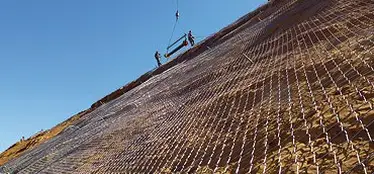
TECCO® System

TECCO® System

Safety, cost-effectiveness, and sustainability: TECCO® can be used to stabilize virtually any kind of slope, whether it consists of rock or loose soil.
SPIDER® System

SPIDER® System

Secures loose rocks, blocky rocks, rock spurs, overhangs or unstable rock formations with highly irregular surface structures.
DELTAX®

DELTAX®

DELTAX® high-tensile steel wire mesh is a cost-effective solution to protect people and infrastructure against rock fall and slope instability.
GREENAX®

GREENAX®

GREENAX® can be used on slopes, embankments and cuttings where vegetation is to be encouraged.
TECMAT®

TECMAT®

Erosion control mat with a three dimensional structure for successful revegetation.
Rolled Cable Net QUAROX®

Rolled Cable Net QUAROX®

QUAROX® rolled cable net is as robust as a wire rope net and as easy to install as rock protection meshes.

FAQ

How can slopes be stabilized?

There are different ways to stabilize slopes. Classical methods, such as concrete walls and shotcrete, that withstand higher driving forces are being studied at universities. Since 2000, flexible facings made from high-tensile wire have been available on the market, which can be dimensioned and can replace concrete and shotcrete. Advantages include open, well-drained, flexible systems that can be greened in soil, with a very natural appearance, and are seen as a green solution.

What is the TECCO® System and what is it used for?

TECCO® is a high-tensile wire mesh-based slope stabilization system designed to secure shallow instabilities on natural and engineered slopes. It includes mesh, spike plates, connection elements and soil nails. The system is dimensioned using the RUVOLUM® approach and specified as a complete system, not as individual components.

What are the main components of the system?
  • TECCO® Mesh
    High-tensile steel wire mesh (2, 3 and 4mm diameter) with diamond-shaped openings

  • Soil/Rock Nails
    Steel nails or bars anchored into the slope

  • Spike Plates
    Plates to tension and secure the mesh to the nails

  • Connection Clips
    IUsed to join adjacent mesh panels

  • Boundary Ropes
    Secure mesh edges and accommodate contouring
How does the TECCO® system work?

The mesh is mechanically fastened to the slope via nails and prestressed using spike plates, pulling the mesh tightly against the terrain. This tensioned mesh restricts surface deformation and blocks stones or debris from falling.

Which approvals and standards apply?

Specifications refer to EAD 230025-00-0106 (Group 1/2/3/4; Class A) and require CE marking with verified characteristic values (Bearing resistance against puncturing, bearing resistance against shearing-off at the upper part of the spike plate, bearing resistance against slope parallel tensile stress and elongation).

What TECCO® mesh variants are common?

Common meshes include G45/2, G65/3, G65/4, and stainless versions (TECCO® STAINLESS) for highly corrosive environments.
Standard roll width is 3.9 m, length 30 m.

Where is the TECCO® system used?

It is used to stabilize:

  • Steep slopes in rock and soft soils

  • Loose or weathered rock faces to prevent breakout

  • Locations where standard rockfall barriers cannot be installed (e.g., due to limited space)
What is TECCO® STAINLESS and when is it used?

TECCO® STAINLESS extends the standard product manual with stainless steel components for high-corrosion environments (e.g., coastal, C4 and C5 exposure). The appendix to the installation manual outlines system components, liability, and maintenance requirements. It is also used where a lower total cost of ownership is desired, as the material lasts longer and requires less maintenance. Stainless steel is used as a more sustainable solution in normal environments due to the longer lifetime. Please note that STAINLESS is available in different grades. It is important to ensure that it is high-quality STAINLESS. TECCO uses 1.4462 (AISI318), which is of very high quality.

Are there CO₂ comparisons versus shotcrete?

Yes. An independent study shows TECCO® has a significantly better CO₂ footprint than shotcrete solutions due to lower material use and simpler installation.

How is TECCO® designed?
  • With RUVOLUM® for soil slopes and loose or weathered rock faces.

  • With RUVOLUM® 3D for advanced design and sustainability metrics.

  • With RUVOLUM® ROCK (available later 2026) for block protection on rock slopes.

Contacts

Saleh Feidi
   

Saleh Feidi

Natural Hazards
Impact Protection
Bryant Jackson
   

Bryant Jackson

Natural Hazards
Impact Protection
John Kalejta
   

John Kalejta

Regional Manager Rocky Mountains / Central USA

Natural Hazards
Impact Protection
Robert Long
   

Robert Long

Regional Sales Manager Southeast

Natural Hazards
Impact Protection
Pierce Runnels, Civil Engineer
     

Pierce Runnels, Civil Engineer

Sales Director North America

Natural Hazards
Tim Shevlin
   

Tim Shevlin

Natural Hazards
Impact Protection