美国
美国

myGeobrugg

The danger of rockfalls is increasing due to climate change. This was once restricted to mountainous regions, but expanding urban areas close to rocky slopes are increasingly at risk. Conventional protective structures are often unable to withstand those risks. We have solutions for every rock fall hazard from low to exceptionally high impact energy levels.
 

落石防护

落石防护

The danger of rockfalls is increasing due to climate change. This was once restricted to mountainous regions, but expanding urban areas close to rocky slopes are increasingly at risk. Conventional protective structures are often unable to withstand those risks. We have solutions for every rock fall hazard from low to exceptionally high impact energy levels.

系统
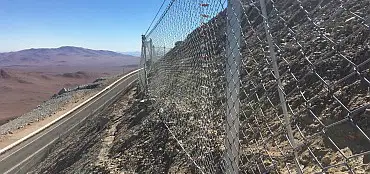
GBE落石防护系统

GBE落石防护系统

我们的GBE落石防护网是一种既经济又可靠的落石防护方法。
RXE型落石防护系统

RXE型落石防护系统

RXE型落石防护系统可在狭窄陡峭的边坡安装并提供最高的安全等级防护。防护能级高达10,000 kJ。
Rockfall protection barriers ROCCO

Rockfall protection barriers ROCCO

ROCCO rockfall barriers exeed the safety requirements of the current standards.
缓冲式拦挡系统

缓冲式拦挡系统

缓冲式拦挡系统(attenuator barrier)能消散落石能量,将岩石挡至坡脚(catchment zone)。这种防护系统允许移除岩石,无需额外耗财费时。
悬臂及柔性棚洞

悬臂及柔性棚洞

布鲁克落石防护网几乎不需要维护,悬臂及柔性棚洞防护系统可使拦截落石弹落到安全区域,因此该系统几乎不需要后期维护,因而可大大减少后续维护费用。
窗帘式防护网

窗帘式防护网

高强度钢丝网制成的和窗帘式防护网就经济和安全而言可替代落石防护网。
ROCKFALL-X

ROCKFALL-X

重量轻、模块化安装的系统构件有效降低了施加于廊道上的静态载荷,易于安装且减少了落石事件发生后的维护工作。
Mobile Road Fencing

Mobile Road Fencing

Road fencing: safe, temporary protection

FAQ

Do you have an example how rockfall ringnets work?

Yes. A spectacular example of how a Geobrugg Rockfall Barrier can stop even the most powerful rockfalls. In February 2026, the N-634 national road along the Basque coast, between Zumaia and Getaria (km 23+500), suffered a major rockfall involving a block of considerable size.
Thanks to the RXE-500 barrier — with an energy absorption capacity of 500 kJ — the falling mass was fully contained, preventing a massive block from reaching the road surface. 

What energy levels can rockfall barriers absorb?

Modern flexible barriers cover a wide range:

  • GBE line: ~100 kJ to 5000 kJ

  • ROCCO line: ~500 kJ to 3000 kJ

  • RXE line: up to 12500 kJ (tested with 25-ton block at 115 km/h / total absorbed energy 14100 kJ). Energy class selection depends on block size, fall height, and site risk assessment.

Ref: EAD 340059-00-0106, Geobrugg Technical Data

What are typical barrier heights?

Heights: 2 m to 6 m, sometimes more.

This depends on project requirements.

Higher systems are possible. In practice, heights of up to 10 meters have already been installed. However, it is not only the height that is important, but also how the barrier has been tested and what energy absorption is possible in the upper area. Systems that have only been tested according to EAD generally have a significantly lower energy absorption capacity in the upper barrier area.

What design standards apply to flexible rockfall barriers?

A frequently used standard is EAD 340059-00-0106.
However, additional local requirements are often required, as EAD only covers minimum requirements.

What are typical barrier deflections?

Deflection varies by system and energy class; low-deflection systems (e.g., RXE) are ideal for tight spaces. Lower deflection usually means higher anchor forces. Deflection is specified by the SEL (Elongation on 30% of test energy) and MEL (Elongation on 100% of test energy).  It makes sense to consider this on a project-by-project basis so that the ideal barrier type (GBE, RXE or ROCCO) can be used for the project in question.

What does MEL stand for?

MEL stands for maximum energy level and indicates how many kJ a barrier has been tested with. In addition to the MEL, it is also specified where this was tested on a rockfall barrier. MEL without designation is always in the middle of a midfield (less critical symmetrical impact). There are also MEL tests that are performed asymmetrically, designated MEL-E, and those that test single-field barriers and edge fields, designated MEL-S.

What is the difference between MEL and SEL energy levels?
  • MEL defines maximum impact capacity (100%).
  • SEL defines serviceability after impact (30%).
How is certification handled and what does it cover?

Certification follows EAD 340059-00-0106 (formerly ETAG 027). Tests include Maximum Energy Level (MEL) and Service Energy Level (SEL) impacts. Certification guarantees tested performance under controlled conditions in the middle of a middle field. It does not cover any site-specific hazards.

The test procedure is purely a comparative test with a load placed in the center of a midfield. This is the least critical case, as the load case is symmetrical and there is net and rope buffer in the center, where the system can dissipate energy. This certification is only required to trade materials in the EU. However, it has nothing to do with practical application in the field. To ensure practical suitability, it makes sense to require additional tests outside of the idealized test procedure in tenders in order to guarantee functionality in practice.

What is the expected lifespan of a rockfall barrier?

The EAD defines a service life of 25 years for corrosion class C2. For corrosion class C3, the EAD defines a minimum of 10 years. These values represent minimum approval requirements. In practice, they are not sufficient.
Modern rockfall barriers are designed for much longer lifespans. At Geobrugg, components are coordinated to achieve minimum 70 to 80 years in C2 environments. In C3 environments, practical experience shows a minimum lifespan of around 25 years. This is a minimum value. In many cases, the actual lifespan is significantly longer.
The decisive factor is consistent coordination of all components. No single component may have a significantly shorter lifespan than the system. It makes little sense to e.g.  specify the highest corrosion protection for the mesh while selecting lower protection levels for ropes or shackles. Shackles, wire rope clips, and bolts are especially critical components. Some suppliers use low quality parts. This can reduce the overall lifespan by up to a factor of eight.

Ref: EAD 340059-00-0106, Geobrugg Technical Recommendations

How often should barriers be inspected?

After installation, an initial inspection is required. At least one inspection per year is recommended. Additional inspections are required after significant rockfall or severe weather.
Inspection frequency depends on the location of the structure. In areas with high rockfall activity, multiple inspections per year are advisable. Many regulations require inspections after every heavy rainfall event, because intense rainfall can trigger rockfall. In practice, this approach is often not feasible. Access is limited or costs become disproportionate. Monitoring technologies such as Geobrugg GUARD can support this challenge. This reduces the need for site visits after every heavy rainfall. A physical on-site inspection remains strongly recommended. Final inspection requirements usually depend on local regulations and authorities.

What does maintenance involve?

Check ropes, brakes, mesh for deformation or corrosion. Remove debris and vegetation. Replace damaged components, re-tension ropes if needed. Use only certified spare parts to maintain CE compliance.

Ref: Geobrugg Maintenance Guidelines

Can damaged parts be replaced individually?

Yes. Components like mesh panels, ropes, and brake elements, posts can be replaced without dismantling the entire barrier. Geobrugg has since 2025 set up a modular barrier design, which is done to replace parts easier to save costs. If necessary, it makes sense to consult with a Geobrugg specialist to implement this quickly and cost-effectively.

How do barriers perform under repeated impacts?

Flexible barriers are designed for multiple events. After major impacts, the remaining capacity is reduced. Inspection and possible component replacement restore full performance.
Current certification covers multiple events only in a limited way. The EAD considers successive SEL1 and SEL2 impacts. Both impacts occur in the center of the same middle field. The energy level is limited to 30 percent of the maximum energy.
Real events rarely occur in the center of a middle field. Impacts often occur near posts or in edge fields. Asymmetric load cases are common. To address these realities, advanced systems are required. Barriers such as the ROCCO line are explicitly tested for this purpose. Testing includes multiple SEL impacts at different locations. Maximum energy impacts in edge fields are also verified. Asymmetric impact scenarios are covered. In addition, some designs are tested for simultaneous impacts. Two rocks hitting the barrier at the same time are proven to function. For real projects, minimum EAD requirements are often not sufficient. Specifying higher performance criteria increases safety and reliability.

Are the barriers recyclable and sustainable?

Yes. Steel components are recyclable; EPDs show high scrap content. Sustainability is increasingly documented in product declarations.

Ref: EPD Documentation

What monitoring options exist?

IoT-based systems like Geobrugg GUARD provide real-time data on rope tension, corrosion, and impact events, reducing manual inspections and improving safety.

Ref: Geobrugg GUARD Brochure

What happens if the barrier is overloaded?

Exceeding design energy may cause structural failure or excessive deformation. Preventive measures include hazard reassessment and installing higher-class barriers or hybrid solutions.

Ref: ETA Guidelines

联系我们

Saleh Feidi
   

Saleh Feidi

自然災害防護
Impact Protection
Bryant Jackson
   

Bryant Jackson

自然災害防護
Impact Protection
John Kalejta
   

John Kalejta

Regional Manager Rocky Mountains / Central USA

自然災害防護
Impact Protection
Robert Long
   

Robert Long

Regional Sales Manager Southeast

自然災害防護
Impact Protection
Pierce Runnels, Civil Engineer
     

Pierce Runnels, Civil Engineer

Sales Director North America

自然災害防護
Tim Shevlin
   

Tim Shevlin

自然災害防護
Impact Protection